The effect of lead oxide concentrations on the bioluminescence intensity of Panellus stipticus
(1) King High School
https://doi.org/10.59720/24-385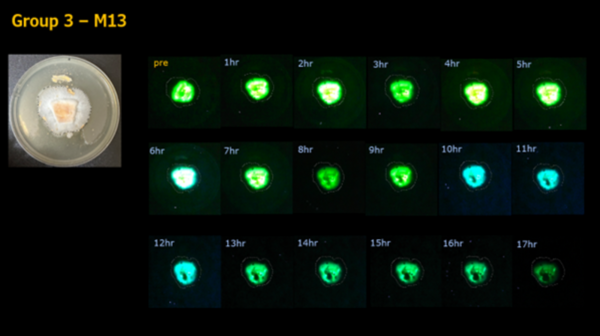
Lead is a heavy metal that pollutes soil and water, causing a variety of health issues. As fungi are crucial decomposers and colonize various environments, including lead-contaminated soils, they can serve as bioindicators for heavy metal toxicity. Panellus stipticus, a bioluminescent fungus commonly found on decaying wood, is an especially promising organism because changes in its cellular health due to a stressor like lead can be quantified by measuring the intensity of mycelial bioluminescence. The objective was to examine if P. stipticus could be used as an effective and sustainable method for detecting the presence of lead in an environment’s soil. In this study, we examined how different lead oxide concentrations affect the bioluminescence intensity of a bioluminescent fungus, P. stipticus, over time. We hypothesized that when the concentration of lead present increases, the bioluminescence intensity of P. stipticus would exhibit a statistically significant decrease. We subcultured 20 P. stipticus samples on malt extract agar, then divided the plates into four groups exposed to different lead oxide concentrations. We quantified bioluminescence intensities via mean pixel brightness analysis through digital imaging. We found that higher lead oxide concentrations cause bioluminescence intensity to decrease over time, yet increasing concentrations of lead oxide did not necessarily cause a significant increase in the rate at which bioluminescence intensity was reduced. The results imply that P. stipticus could be used as a sustainable, effective method for detecting the presence of lead in an environment, helping to reduce the cases of lead poisoning through early detection.
This article has been tagged with: