Predicting sickle cell vaso-occlusion by microscopic imaging and modeling
(1) New Trier High School, (2) Department of Pathology, Northwestern University, (3) Columbia University, (4) Richard and Loan Hill Department of Biomedical Engineering, University of Illinois
https://doi.org/10.59720/24-376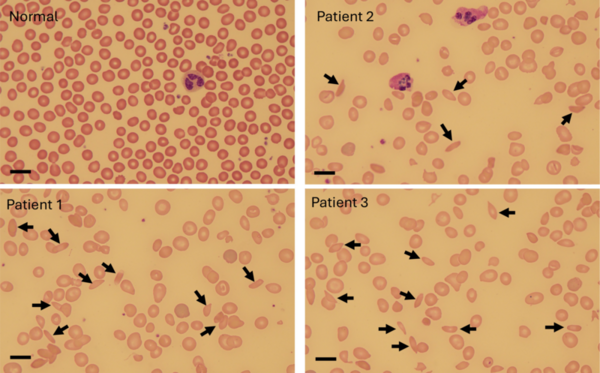
Sickle cell disease (SCD) is a hereditary condition in which red blood cells become rigid and develop a sickle shape due to abnormal hemoglobin S. This leads to obstructed microvasculature and causes vaso-occlusive crises (VOCs). These blockages result in severe complications like pain crises, acute chest syndrome, and strokes. The physical mechanisms behind VOCs are not fully understood, hindering the development of predictive diagnostic tools. Previous studies using microfluidic devices and mathematical modeling to analyze the transit of sickle red blood cells through microvasculature-mimicking slits found that increased viscosity is positively related to longer transit times, which can predict disease severity. Since blood viscosity is positively correlated with the frequency of sickle red cells, we hypothesized that a higher percentage of sickle cells in peripheral blood would correspond to a greater likelihood of VOCs in SCD patients. To test this hypothesis, we used the software ImageJ to analyze blood smear images from 24 SCD patients to quantify the percentage of sickle cells. We found a positive correlation between sickle cell frequency and the incidence of VOC events. These findings suggest that blood smear imaging combined with microfluidic analysis and mathematical modeling could serve as a rapid, non-invasive diagnostic tool to predict pain crises in SCD patients. This approach has significant clinical implications, offering a potential method to predict VOC events for personalized treatment strategies, ultimately aiming to reduce hospital admissions and improve outcomes in SCD patients.
This article has been tagged with: