The impact of visual attention on visual working memory
(1) Synapse School, (2) Synapse School and Stanford University
* These authors made equal contributions
https://doi.org/10.59720/24-366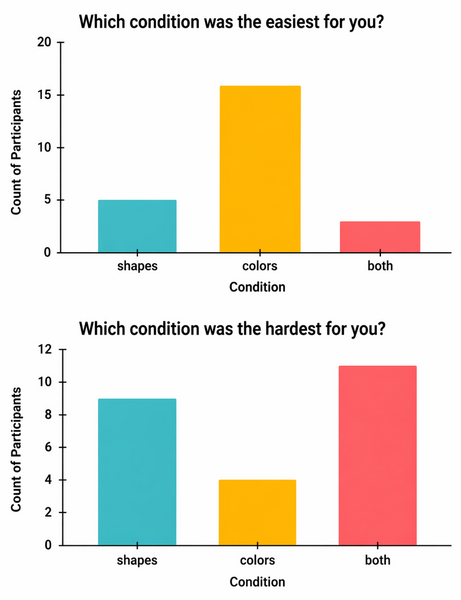
The multimodal model of memory proposes that information is passed through three separate memory stores. One type of memory is working memory, which is used to store and manipulate information for a short period. Currently, little is known about working memory and its relationship to attention in adolescents, and our study aimed to address this gap. We investigated whether the information stored in working memory depends on the focus of a person’s attention, which is relevant to the classroom environment. For our study, we designed a within-subjects change detection task that examined two variables: 1) attentional cue (image shape, color, or both) and 2) memory load (two, four, or eight items). After participants were given an attentional cue, they identified changes in sequences of colored shapes. We measured behavioral responses using reaction time, accuracy, and working memory capacity. Our first hypothesis was that participants’ accuracy and capacity would be higher, while reaction time would be lower, if they were paying attention to only shape or color instead of both. Our second hypothesis was that accuracy and capacity would decrease, while reaction time would increase, as memory load increased. Our results did not line up with our first hypothesis because we found that participants did better when paying attention to just colors compared to shapes or both; however, our second hypothesis was supported by our findings. The findings in this study help us understand the relationship between working memory and attention, with implications for how efficiently students retain new information.
This article has been tagged with: