Large-scale brain network connectivity under anxiety induced by naturalistic story listening
(1) Branham High School, (2) Department of Biomedical Sciences, College of Medicine, Korea University
https://doi.org/10.59720/24-360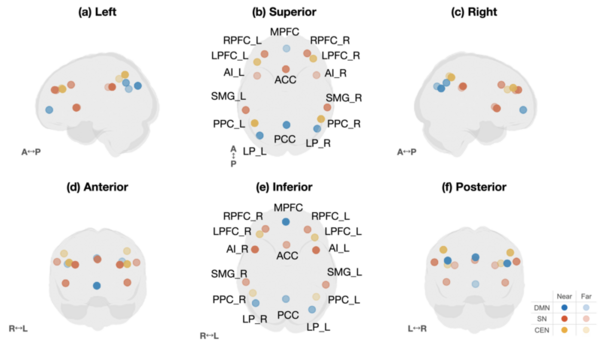
The triple network model, encompassing the salience network (SN), default mode network (DMN), and central executive network (CEN) in the brain, provides a framework for understanding how anxiety influences brain activity. Dysfunction in these networks is linked to anxiety disorders, suggesting their interaction is key to the condition. We hypothesized that anxiety from naturalistic story listening alters functional connectivity within this model. Specifically, we predict that at the story's peak tension, the anxiety-induced group will show significantly different connectivity—particularly increased network density—between the SN, DMN, and CEN compared to a control group. This naturalistic approach mimics real-life anxiety, unlike traditional artificial stressors. We tested this hypothesis using a previously published functional magnetic resonance imaging (fMRI) dataset where anxiety was manipulated during story listening. The story, Pretty Mouth and Green My Eyes, was narrated to two different groups; one anxiety-inducing (experimental) and one neutral (control). Consistent with this prediction, the network density (i.e., the degree to which different brain regions communicate), was significantly greater in the experimental group compared to the control group. In particular, the CEN serves as a bridge tightly connecting the DMN and SN, which may be interpreted as empathy and emotion coming together under focused attention when experiencing tension. Our findings demonstrate that anxiety and tension during reading significantly alter the functional connectivity of the SN, DMN, and CEN. This research provides a possibility for creating accurate diagnostic tools and personalized treatments for anxiety disorders by comparing connectivity patterns of those without and with anxiety disorders.
This article has been tagged with: