Understanding the correlation between various pollutants and cancer across geographical clusters in the U.S.
(1) The Overlake School, (2) Alumni, Massachusetts Institute of Technology
https://doi.org/10.59720/24-322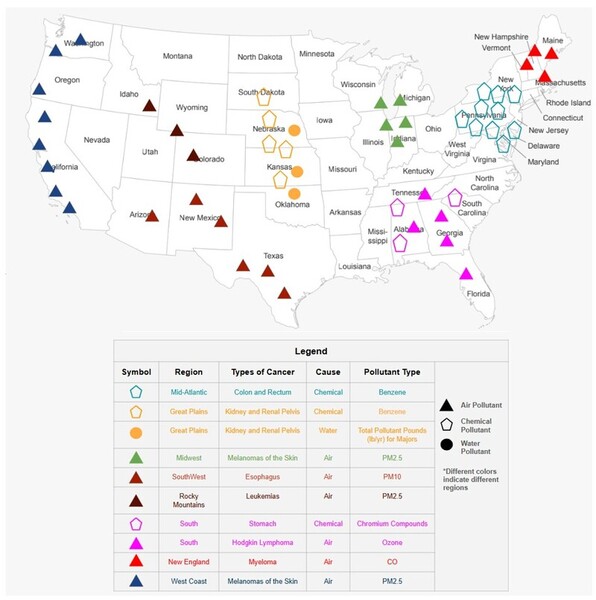
Air, water, and chemical pollutants harm human health by damaging vital organs, causing gastrointestinal and neurological issues, and contributing to cancer and immune system dysfunction. Many prior studies have shown that the risk of obtaining life-threatening diseases in humans increases when exposed to high concentrations of pollutants. Our study explored whether different types of pollutants are positively correlated with cancer incidence rates. We hypothesized that there is a statistically significant positive correlation between environmental pollutants and cancer incidence rates across different geographical clusters of the United States. We used the Pearson correlation coefficient to measure the strength of the correlation across three years (2018–2020). To assess statistical significance, we calculated a t-statistic for each coefficient, with p < 0.05 considered statistically significant. Thirty-six different types of cancer and twelve pollutant metrics were analyzed using publicly available data from the Centers for Disease Control and Prevention (CDC) and Environmental Protection Agency (EPA). Our research showed that certain clusters in the United States showcase a strong correlation between different environmental pollutants and various cancers. These findings can potentially help prevent premature deaths caused by cancer and help explain why certain states in the United States have larger cancer incidence rates than others.
This article has been tagged with: