The correlation between the phase of the moon and the number of psychiatric patients admitted to the hospital
(1) North Broward Preparatory School, (2) Department of Pediatrics, Broward Health
https://doi.org/10.59720/24-303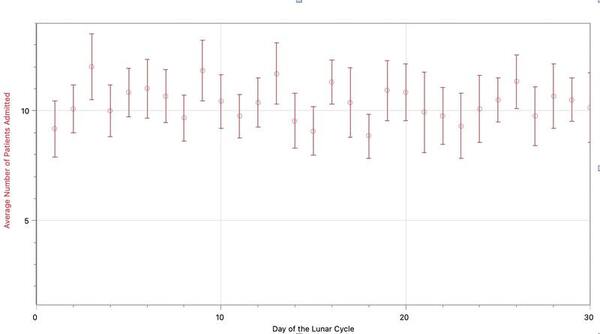
Each lunar cycle is 29.5 days long, and many medical professionals believe that the presence of a full moon will increase the incidence of medical emergencies, including psychiatric incidents. While previous studies suggest lunar phase could impact human health, mental state, and physiology, a direct relationship between lunar phase and number of psychiatric admissions had not previously been investigated. We hypothesized that as the monthly moon phase neared a full moon, during the Lunar-Gibbous phase, the average number of psychiatric patients would increase significantly, peaking on day 15 (full moon). Data consisted of 5,987 patients admitted to 4 psychiatric facilities over the course of 3 years. The numbers of psychiatric admissions for each day of the lunar cycle were displayed on a trend-line graph, and groups separating days of the lunar cycle were compared using a statistical two-sample t-test. The p-value was found to be approximately 1.60 x 10⁻¹², indicating a significant difference between the Lunar Gibbous and Lunar Non-Gibbous groups. However, contrary to the hypothesis, psychiatric admissions were lower during the gibbous phase compared to the non-gibbous phase, suggesting a potential negative correlation. As such, the original hypothesis was not supported, and further research is needed to investigate potential factors contributing to this result. These findings challenge existing assumptions about lunar influence on mental health and highlight the importance of using empirical evidence to inform psychiatric theory and practice.
This article has been tagged with: