The effect of nanosilver particles on the lifespan of Daphnia magna in pond water
(1) North Bay Haven Charter Academy
https://doi.org/10.59720/24-244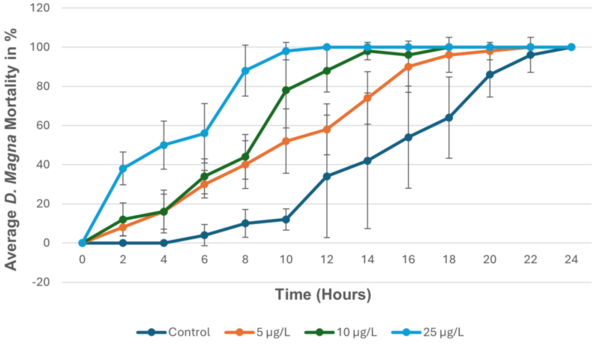
Nanosilver particles are currently used in over 1,000 consumer products because of their ability to kill fungi and bacteria by attaching to and penetrating their cell wall. Nanosilver particles are utilized in the production of consumer goods; however, a deficiency in research exists when it comes to potential harmful effects on the environment. The purpose of our research was to determine the effect of silver nanoparticles on Daphnia magna in pond water. D. magna are a species of water flea that have previously been used as an indicator species for the health of pond ecosystems. We hypothesized that the D. magna exposed to the highest concentration nanosilver particle (25 µg/L) would reach 100% mortality the quickest and exhibit a shorter lethal time (LT50) compared to the control and the lower concentrations of nanosilver particles (5 µg/L and 10 µg/L). We saw that D. magna exposed to 25 µg/L silver nanoparticles reached 100% mortality the fastest (9.6 hours) compared to D. magna exposed to the 5 µg/L and 10 µg/L concentrations. Our findings provide evidence that a means of preventing nanosilver particle runoff into the environment is necessary in order to prevent ecological damage.
This article has been tagged with: