Drought prediction in the Midwestern United States using deep learning
(1) Ladue Horton Watkins High School, (2) Silver School of Social Work, New York University
https://doi.org/10.59720/24-243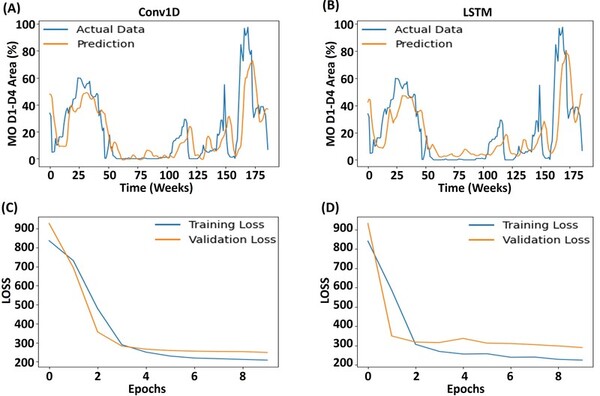
Drought is a recurrent and natural phenomenon that has had economic, agricultural, and social effects on the Midwestern United States (U.S.). While many drought prediction models exist, none are specifically designed to forecast drought occurrences in the Midwestern U.S. Therefore, an opportunity exists to develop a drought prediction model that would be more accurate for the Midwest. In this study, we used deep learning models to train a drought prediction model for the Midwest. After comparing the Conv1D and LSTM models, we chose the Conv1D architecture to develop a drought forecasting model trained on 23 years of weekly data from the U.S. Drought Monitor. The hypothesis is based on the significant role of existing drought and precipitation status in influencing drought conditions and the importance of selecting an appropriate look-back period (temporal window) for accurate forecasting. We hypothesized that optimizing the temporal window of precipitation data input (e.g., using 10 weeks of data) would lead to more accurate drought predictions. Given the time series nature of drought data, the size of the input temporal window plays a crucial role in prediction accuracy. Our model achieved averages of 0.904 for the Pearson correlation coefficient across 12 different Midwestern states, indicating a high level of consistency in the model’s accuracy. The study findings suggest that a deep learning model with a properly optimized temporal window provides a viable approach for drought forecasting in the Midwest.
This article has been tagged with: