Using heptane to extract almond oil
(1) Willamette Valley Academy, (2) Carmenita Middle School, (3) East Samford School, (4) Weerye Elementary School, (5) Oregon Episcopal School, (6) Griffin Middle School, (7) George Fox University, (8) Loyola University Maryland, (9) Georgetown University, (10) Rice University
https://doi.org/10.59720/24-215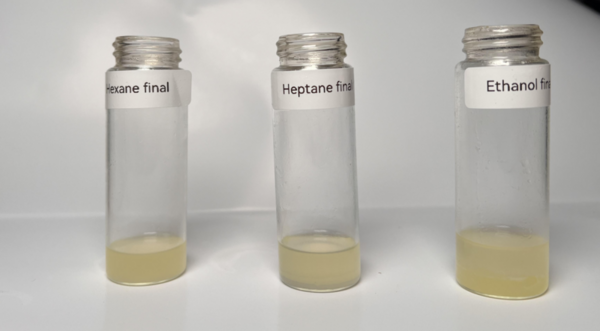
Essential oils are mainly extracted out of plants, such as leaves, flowers, bark, and fruit mainly by distilling or pressing. Out of numerous separation methods such as distillation, extraction, sublimation, and chromatography, many companies favor extraction methods over others to extract different oils, which possess great health benefits, including cardiovascular support, skin care, brain function support, and cancer prevention. There are multiple solvents available for almond oil extraction, such as hexane, ethanol, toluene, methanol, acetone, chloroform, diethyl ether, dichloromethane, and combinations thereof. For almond oil extraction, companies typically use either hexane or methanol. However, hexane and methanol are toxic for human consumption and can cause health problems such as nerve damage, blindness, and even irreversible brain damage. For this reason, we hypothesized that a safer chemical, such as heptane, could also be used to extract oils given its chemical structure's similarity to hexane. We were able to extract mixture oil using ethanol, hexane, and heptane and found that heptane and hexane have similar amounts of extracted oil, most likely due to the similar chemical structure between hexane and heptane. Our results show that the extractions overall yielded a reasonable amount of oil extraction from almonds.
This article has been tagged with: