Investigating intertidal sediment sorting and median particle diameter variation on an eroding beach face
(1) Wantagh High School
https://doi.org/10.59720/24-146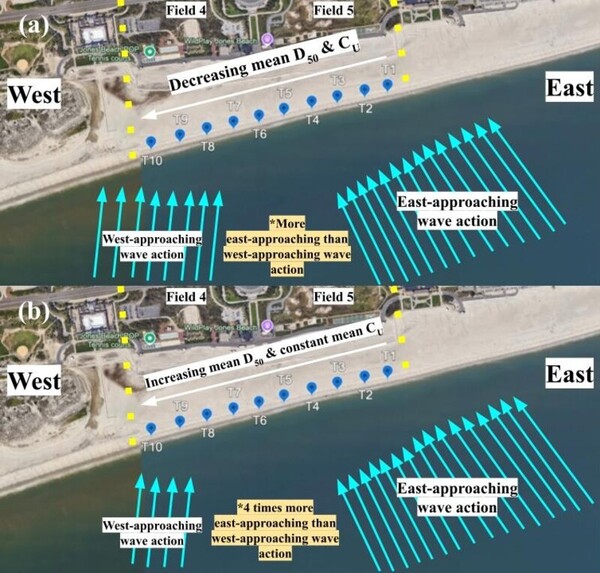
Climate change and rising sea levels are worsening coastal erosion, endangering coastal economies, communities, and ecosystems. Beach nourishment projects seek to combat this erosion, but the lack of information about spatial grain size variation and sediment transport systems limits the success of current efforts. It is imperative to understand these properties to accurately predict the retention of nourishment sediment after beach nourishment occurs. In this study, we investigated how grain size varies spatially on two example fields at Jones Beach, New York, to provide further insight into how sediment is sorted in the transport direction on beach faces. We chose Fields 4 and 5, public beach sites at Jones Beach on the southern coast of Long Island, as the study site because of their popularity and extensive developmental status, meaning coastal erosion could hinder future recreation and construction. Based on previous sediment transport models, we hypothesized that the sediment along the coastline of Fields 4 and 5 becomes progressively finer and better sorted from east to west. The sieve analysis indicated that median grain size, on average, increased from east to west while sorting remained constant. Offshore wave climate data, consisting of waves’ heights and directions, revealed that the site experiences more east-approaching than west-approaching significant wave action. Our findings may enhance sediment transport modeling at Jones Beach and other eroding coastlines, informing beach nourishment projects vital for mitigating erosion.
This article has been tagged with: