Chlorpyrifos exposure in mice leads to altered expression of key neurodevelopmental proteins
(1) Fulton Science Academy, (2) Gangarosa Department of Environmental Health, Rollins School of Public Health, Emory University
https://doi.org/10.59720/24-145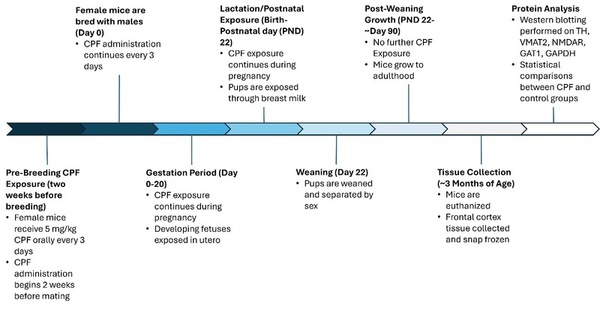
Exposure to organophosphates in humans has been linked to adverse neurodevelopmental effects. Chlorpyrifos (CPF) is an organophosphate insecticide used widely in a variety of settings. Although some countries have banned or restricted the use of CPF, particularly in agriculture, other applications still continue. In an effort to predict the potential neurodevelopmental impact of CPF on humans, we investigated the effects of CPF exposure in mice. Specifically, we measured changes in levels of four proteins found in the frontal cortex, tyrosine hydroxylase, vesicular monoamine transporter 2, N-methyl-D-aspartate receptor, and gamma-aminobutyric acid transporter 1 in the frontal cortex. We hypothesized that the levels of these proteins would change upon exposure to CPF. The results of the experiments indicated that significant increases and decreases occurred in all four proteins in both the male and female mice upon CPF exposure. The results were sex-dependent; for example, CPF exposure induced a significant decrease in NMDAR expression in males and a significant increase in females. Changes in these proteins are associated with several mental health conditions including schizophrenia, depression, cognitive and social deficits, and Parkinson’s disease. Thus, our findings highlight the risk of neurodevelopmental concerns in neonates due to pre- and postnatal exposure to CPF.
This article has been tagged with: