Investigating the impact of short-chain fatty acids on myofiber dynamics and insulin sensitivity
(1) Mulgrave School, (2) Department of Pharmacology, Weill Cornell Medicine
https://doi.org/10.59720/24-126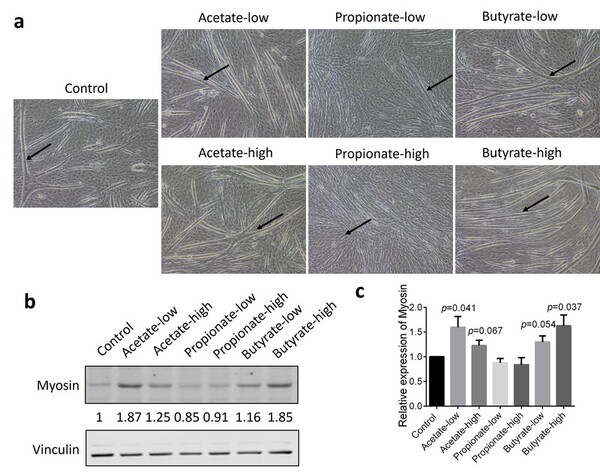
Sarcopenia is a condition characterized by age-associated decline in skeletal muscle health. This condition, especially given the increasing prevalence of metabolic dysfunction with aging and recent recognition of the pivotal role of metabolism in sarcopenia, has become an urgent health concern. The rising incidence of obesity and metabolic disorders further underscores the need to explore metabolites as potential therapeutic targets. Short-Chain fatty acids (SCFAs), a group of metabolites abundant in the human body, are promising modulators of muscle physiology. However, their individual roles in muscle fiber dynamics and insulin sensitivity require further exploration. We hypothesized that all SCFAs would exert similar effects on muscle fiber formation and insulin sensitivity in a concentration-dependent manner. To test our hypothesis, we investigated the impacts of SCFAs on myofiber differentiation and degradation using C2C12 mouse myoblasts as a model. We found that SCFAs, particularly acetate and butyrate, exerted concentration-dependent effects in promoting muscle fiber formation. In contrast to our hypothesis, propionate promoted myofiber degradation and inhibited myofibroblast differentiation. The inhibition of myofibroblast differentiation by propionate correlated with increased lipid accumulation in muscle fibers and decreased insulin sensitivity. The insights derived from this study contribute to a deeper understanding of nutrient-mediated muscle health. Moreover, they offer potential avenues for targeted interventions aimed at alleviating age-related muscle dysfunction and metabolic challenges.
This article has been tagged with: