Observing food and density effects on the reproductive strategies of Heterandria formosa
(1) Alexander W. Dreyfoos Junior School of the Arts, (2) Department of Biological Science, Florida State University, (3) Department of Integrative Biology, University of California
https://doi.org/10.59720/24-114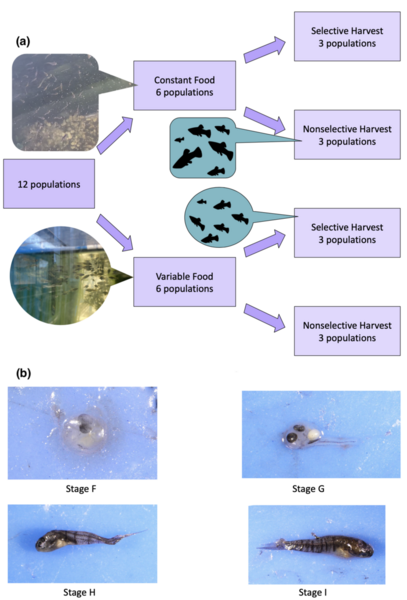
Fishing and climate change have dramatically altered the structure of fish populations over the past century. Heavy fishing and changes in marine ecosystems affecting food availability are hypothesized to have altered not only abundances of fish species, but also important life history traits such as fecundity-body size relationships. Studying such hypotheses in the wild is difficult, so we use the live-bearing fish Heterandria formosa as a model for understanding such impacts more generally. We imposed different experimental harvest and feeding treatments over three generations. Different harvest treatments periodically removed subsets of the population either selectively with respect to body size–removing individuals with the longest body length–or non-selectively. Food treatments varied in whether fish were given constant or variable amounts of added food. To assess how females’ length-specific fecundity and embryo size varied across treatments, for each generation, we subsampled females to measure their embryos. We hypothesized that selective harvest would increase females’ length-specific fecundity. Our results showed fish from the selective harvest populations had higher length-specific fecundity compared to the non-selective harvests. However, these treatments also removed large fish, leading to populations of smaller fish with more embryos per unit mass. Therefore, harvests removing larger fish can alter life history, favoring greater reproduction at smaller sizes. While these changes may appear to bolster individual fitness, such changes may also detract from energy invested in growth and lead to unexpected shifts in individual fitness, population structure, and population viability.
This article has been tagged with: