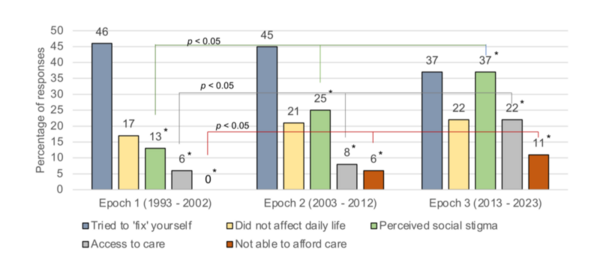
Obsessive-compulsive disorder (OCD) can cause significant impairment, and studies indicate that delays in diagnosis and treatment lead to worse outcomes. This study aimed to assess whether these delays have improved over the past three decades and to identify their causes.
The electronic health record (EHR), along with its mobile application, has demonstrated the ability to improve the efficiency and accuracy of health care delivery. This study included data from 874 health care providers over a 12-month period regarding their usage of mobile phone (EPIC® Haiku) and tablet (EPIC® Canto) mEHR. Ambulatory and inpatient care providers had the greatest usage levels over the 12-month period. Awareness of workflow allows for optimization of mEHR design and implementation, which should increase mEHR adoption and usage, leading to better health outcomes for patients.
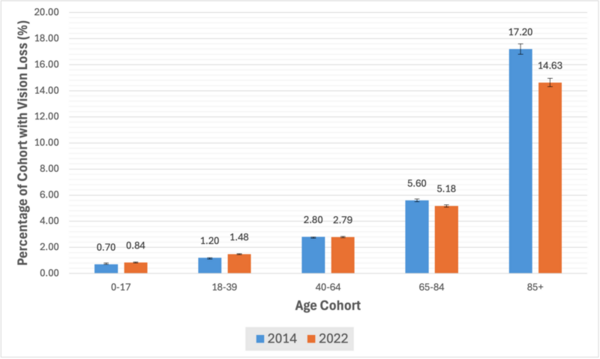
This study examined how social determinants of health (SDH) relate to vision loss by analyzing publicly available data from 18 northern and southern U.S. states and using Bayesian correlation analysis.
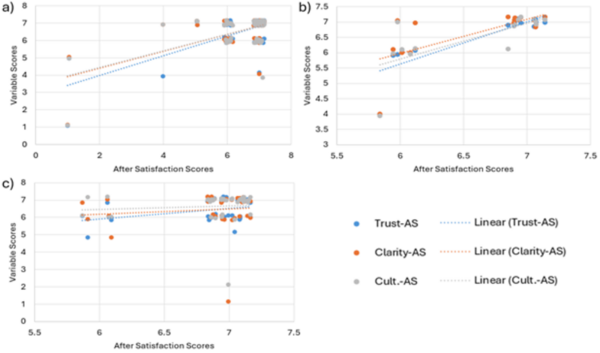
This manuscript explores the use of Spanish language translators in an outpatient clinic in New Jersey. The authors surveyed patients before and after in person, video, and telephone appointments to determine which modality was most acceptable to the patients. The authors found that the three modalities did not differ in patient satisfaction, but that patients were grateful for translations services and that patient trust may be expanded by the use of these services and by focuses of translator soft skills.
Many cases of viral hepatitis are easily preventable if caught early; however, a lack of public awareness regarding often leads to diagnoses near the final stages of disease when it is most lethal. Thus, we wanted to understand to what extent an individual's sex, age, education and country of residence (India or Singapore) impacts disease identification. We sent out a survey and quiz to residents in India (n = 239) and Singapore (n = 130) with questions that test their knowledge and awareness of the disease. We hypothesized that older and more educated individuals would score higher because they are more experienced, but that the Indian population will not be as knowledgeable as the Singaporean population because they do not have as many resources, such as socioeconomic access to schools and accessibility to healthcare, available to them. Additionally, we predicted that there would not be any notable differences between make and females. The results revealed that the accuracy for all groups we looked at was primarily below 50%, demonstrating a severe knowledge gap. Therefore, we concluded that if more medical professionals discussed viral hepatitis during hospital visits and in schools, patients can avoid the end stages of the disease in notable cases.
This article helps in understanding the effect of various social determinants on maternal mortality in the United States. It explains the relationship between maternal mortality rates and factors like race, income, education, and health insurance access.
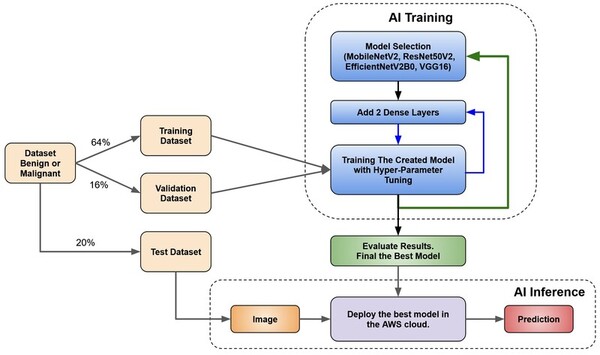
Skin cancer is a common and potentially deadly form of cancer. This study’s purpose was to develop an automated approach for early detection for skin cancer. We hypothesized that convolutional neural network-based models using transfer learning could accurately differentiate between benign and malignant moles using natural images of human skin.
In this study, the authors created a survey to assess misconceptions and knowledge deficits regarding cardiovascular diseases exist among US adults and minors.
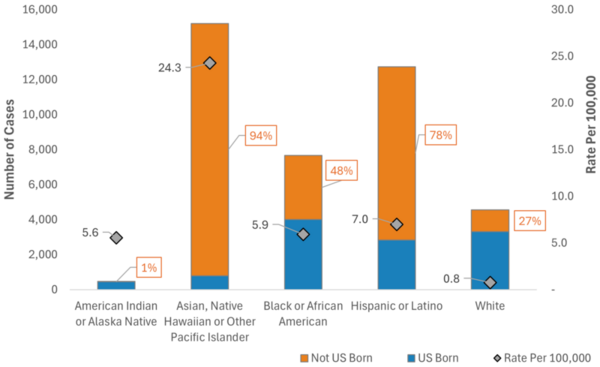
The main goal of this study is to determine what demographics are related to tuberculosis incidence in the United States populations, particularly if changing demographics are related to differences in tuberculosis risk over two discrete time periods. The major finding is that in the two studied time periods, tuberculosis risk factors were somewhat consistent and may be influenced by things such as immigration, healthcare access, and race or ethnicity, although the top predictor did change.
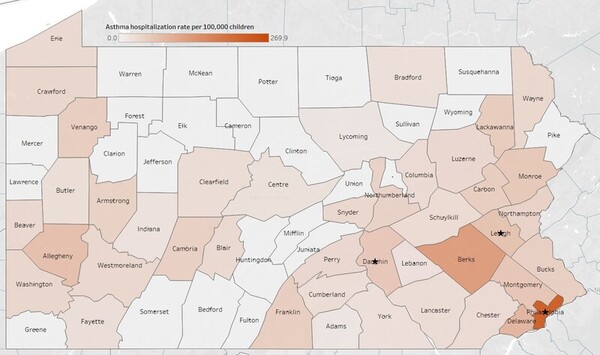
Asthma is one of the most prevalent chronic conditions in the United States. But not all people experience asthma equally, with factors like healthcare access and environmental pollution impacting whether children are likely to be hospitalized for asthma's effects. Li, Li, and Ruffolo investigate what demographic and environmental factors are predictive of childhood asthma hospitalization rates across Pennsylvania.